
Coral joins the Google for Startups Accelerator: AI for the Middle East, North Africa and Turkey
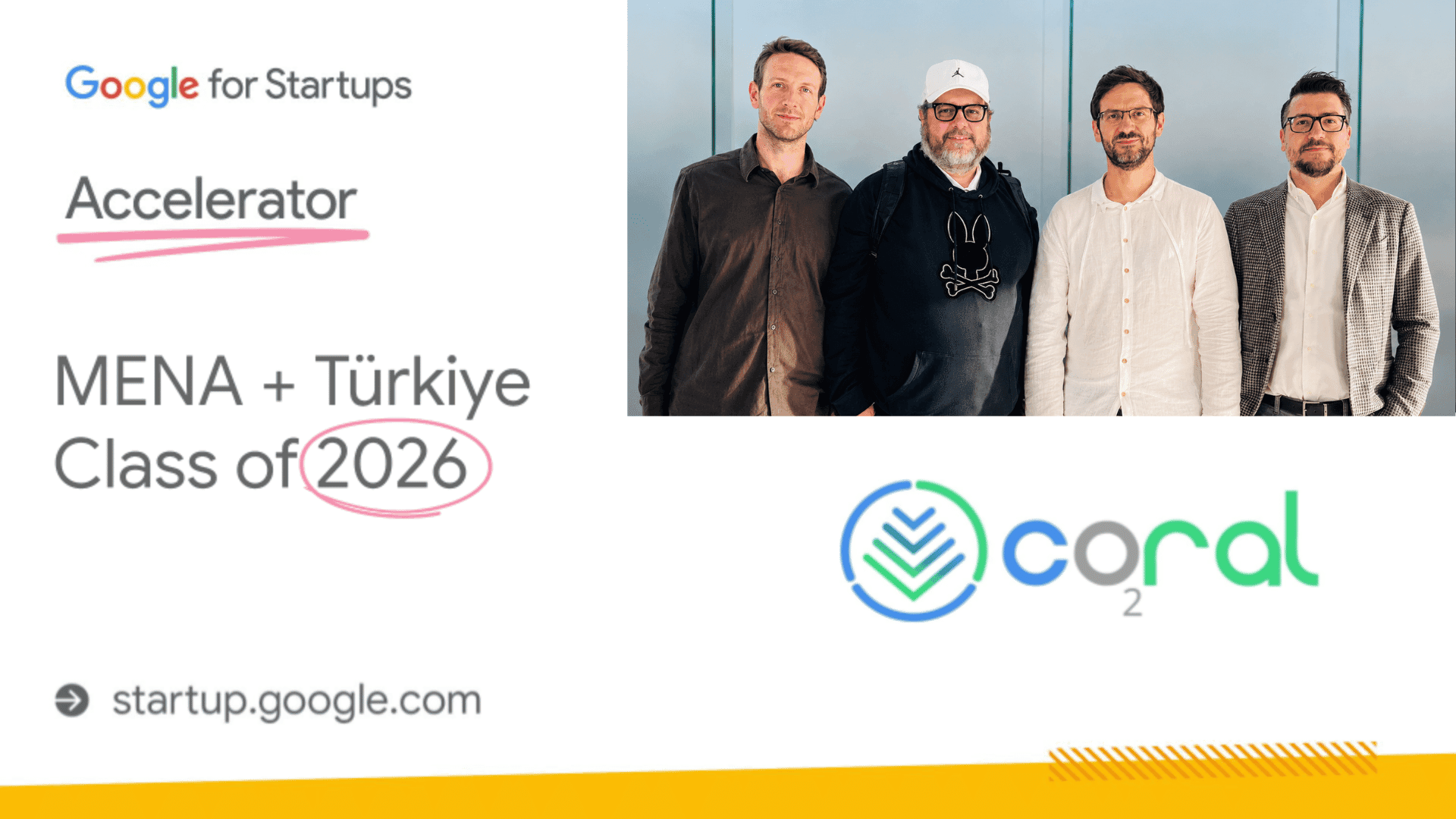
Coral is one of 15 startups selected and the only climate and sustainability data infrastructure company in the Google for Startups Accelerator: MENAT cohort.
Coral has been selected for the Google for Startups Accelerator: AI for the Middle East, North Africa and Turkey; one of 15 startups in a highly selective cohort of AI-native companies from across the region.
It’s a meaningful signal for the category we’ve been building toward from day one: a platform that gives enterprises a single, intelligent, governed data layer for everything climate, carbon and ESG.
“Climate data is, at its core, a data infrastructure problem dressed up as a reporting problem. Joining this program lets us go deeper on the AI architecture that solves it; and it positions Coral inside the most serious cohort of AI builders coming out of this region.”
- -Daniele Sileri, Founder & CEO, Coral
Key takeaways
-
Coral has been selected for the Google for Startups Accelerator: AI for the Middle East, North Africa and Turkey; 1 of 15 startups in the cohort.
-
Coral is the only climate and sustainability data infrastructure company in the cohort.
-
The program validates Coral’s AI-native, infrastructure-first approach to enterprise climate and sustainability data.
-
Coral is already in production with enterprises across very different industries and geographies; including financials, manufacturing, automotive, real estate, data centers, logistics and more.
-
Customers using Coral are closing reporting cycles in weeks instead of months, across frameworks including GHG, CSRD, GRI, IFRS and more.
-
The selection is one of the strongest signals to date that a globally-relevant climate AI infrastructure company can be built from the GCC.
Most enterprises have a data infrastructure problem.
The information needed to manage carbon, ESG, compliance and climate-related decisions sits scattered across invoices, utility bills, ERP systems, procurement records, supplier files, operational logs, spreadsheets, consultant reports and inboxes.
The data exists. It is just fragmented, inconsistent and untraceable.
Every reporting cycle becomes a manual rebuild; teams chasing files, reconciling spreadsheets, validating assumptions, explaining why numbers changed from one version to the next. A dashboard can only show what the underlying data layer can support. If the source data is broken, the dashboard is a prettier version of the same problem.
Already in production across radically different enterprise contexts
Coral is already running in production across very different enterprise contexts; from Trendyol, one of MENA’s largest e-commerce platforms, to OKX‘s a UAE government financially regulated entity, which must meet some of the region’s most stringent disclosure obligations as a regulated digital asset business. Different industries, same fragmented data problem, solved on the same infrastructure.
Customers using Coral are closing reporting cycles in weeks instead of months, across frameworks including GHG, CSRD, GRI, IFRS and more.
What AI-native means at Coral
AI-native means intelligence is built into the architecture; not bolted on top. In practice that looks like:
-
Reading and extracting data from invoices, PDFs and operational files
-
Classifying activity data and mapping it to the right categories and emission factors
-
Identifying gaps, anomalies and inconsistencies before they hit a report
-
Linking every calculated output back to the source evidence that produced it
-
Supporting review, approval and audit workflows end-to-end
But enterprise sustainability data cannot run on black-box automation. Teams, auditors and regulators need to understand where every number came from, what factor was applied, what methodology was used, and who reviewed it.
That’s why Coral pairs AI with governance. The objective isn’t speed alone; it’s technical trust.
Why this matters from the GCC
The GCC is one of the most consequential markets in the world for climate and sustainability infrastructure right now.
-
The UAE’s Climate Law and federal sustainability disclosure requirements are pulling thousands of enterprises into mandatory emissions reporting.
-
Saudi Arabia’s Vision 2030 and the Saudi Green Initiative are creating disclosure obligations across industry, finance and the public sector.
-
Regional banks, sovereign funds and listed companies are aligning with ISSB, CSRD and TCFD on globally comparable terms.
-
Multinationals operating in the region face CBAM, Scope 3 supplier data demands, and parent-company reporting requirements that the typical Excel stack simply cannot serve.
Global ESG software was not built for this context. Multi-entity sovereign structures, mixed Arabic and English documentation, heterogeneous data systems, and rapidly evolving regional regulation demand infrastructure that is regionally fluent and globally credible at the same time.
That is what Coral is building; and being selected for a Google program designed specifically for AI-native companies from MENA, Turkey and Africa underscores the point.
What the program unlocks for Coral
The Google for Startups Accelerator gives selected companies access to Google’s AI expertise, technical mentorship, product guidance and growth support over a ten-week hybrid program, culminating in a Demo Day in September 2026. Concrete benefits for Coral include:
-
Up to $350,000 in Google Cloud and Firebase credits in the first year, subject to terms and conditions
-
Cloud TPU access to accelerate machine learning workloads
-
Early Access Program and Trusted Tester benefits for Google’s AI products
-
Equity-free participation; no dilution
-
1:1 mentoring from Google teams and the wider expert network across AI/ML, Cloud, UX, product strategy and marketing
What this means for Coral’s customers
For the enterprises already running on Coral, this milestone means continued investment in the infrastructure underneath their outcomes.
One trusted data foundation, reusable across:
-
Carbon accounting (Scope 1, 2 and 3)
-
ESG reporting (ISSB, CSRD/ESRS, GRI, CDP, SBTi)
-
Supplier and value chain data
-
Product carbon footprints
-
CBAM-related reporting
-
Financed emissions
-
Internal dashboards and decarbonisation planning
-
Audit and assurance workflows
This is about giving teams infrastructure that actually scales with them.
In the coming weeks we will share more on what Coral’s customers are achieving with this approach; including a closer look at how specific enterprises are transforming their sustainability data operations.
Want to see Coral in action?
If your organisation is still managing climate, carbon or ESG data through scattered spreadsheets and manual reporting cycles, the data foundation should come first. Book a demo and we will walk you through what an AI-native infrastructure layer looks like for an enterprise like yours.
FAQ
What does Coral’s selection for the Google for Startups Accelerator mean?
It’s a regional and technical validation of Coral’s AI-native, infrastructure-first approach to enterprise climate data; and access to Google’s AI expertise, mentorship and ecosystem during a critical scaling phase.
Is Coral an ESG reporting tool?
Coral supports ESG reporting, but the platform is a broader sustainability data infrastructure layer; built to ingest, structure, govern and activate data across emissions, ESG, compliance and climate workflows from one trusted foundation.
What does AI-native mean at Coral?
AI is built into the core architecture; supporting ingestion, document processing, classification, mapping, validation and workflow automation; while every output remains traceable to its source evidence and reviewable by humans.
Why is this relevant for enterprises in the GCC?
Regional enterprises face fast-moving disclosure obligations under the UAE Climate Law, Saudi Vision 2030, ISSB, CSRD, CBAM and more; across multi-entity, multi-geography structures that global ESG software was not built for. Coral is built for this context.
What will Coral focus on through the program?
AI capability, data infrastructure, scalability and tighter integration with Google’s AI ecosystem; with the goal of making the platform a stronger foundation for enterprise sustainability data management.
متعلقہ مضامین
 Carbon Markets & Climate Policy25 ستمبر، 2026
Türkiye’s Carbon Market Pilot: 2026 Data Sets Your 2027 Carbon Bill
Türkiye’s Emissions Trading System (TR ETS) regulation entered into force on 27 August 2026. The Carbon Market Board’s first decision (KPK/2026/1) then set a 2026–2027 pilot for Category B and C installations in five sectors: electricity generation, cement, iron and steel, aluminium and fertilisers. 2026 is a reporting-only year, and carbon pricing starts in 2027. […]
 Emissions Reporting16 ستمبر، 2026
ESRS E3 Water Disclosure in the GCC: What Boards Need to Know
ESRS E3 is the European standard covering water and marine resources. It requires companies to report water withdrawal, discharge, consumption, recycled and reused volumes and water intensity, with separate disclosure for sites located in areas of high water stress. For companies operating in the GCC, nearly every site meets that definition, which changes the shape […]
 Emissions Reporting10 ستمبر، 2026
Dual-Fuel Ships Won’t Cut Your Scope 1 and 3 Automatically
A methanol dual-fuel ship does not lower anyone’s emissions number by itself. What counts is the fuel actually burned and its full lifecycle intensity, measured well-to-wake from production through combustion. Grey methanol, made from natural gas, delivers little to no reduction; only green or bio-methanol, backed by evidence, changes what a Gulf logistics group, port […]