
Going Public in the Gulf? Get Your ESG Data Listing-Ready

DIP Holding began trading on the Dubai Financial Market (DFM) on 11 November 2026 as the UAE’s first IPO of the year, and the companies queuing behind it face a reporting cycle that starts as soon as they list. In the UAE, a listed public joint stock company has to publish a sustainability report inside its integrated annual report, within three months of its financial year-end. On Saudi Exchange (Tadawul), ESG disclosure is still voluntary, but the Saudi Capital Market Authority has just made forward-looking forecasts a mandatory part of every IPO prospectus, which raises the bar for every number an issuer puts in front of investors. For a CFO preparing a listing, ESG data readiness means having a complete, owned and evidenced dataset at least one full year before the first report is due, because a sustainability report cannot be assembled in the weeks before an AGM.
Key takeaways:
- Start ESG data readiness at least 12 months before listing, because the last full financial year before the IPO usually becomes the baseline every later report is measured against.
- UAE public joint stock companies listed on DFM or the Abu Dhabi Securities Exchange (ADX) must include a sustainability report in their integrated report, disclosed within the first three months of the financial year and at least 10 days before the AGM.
- Since 1 January 2026, the UAE’s securities regulator has been the Capital Market Authority (CMA), which replaced the Securities and Commodities Authority (SCA).
- Tadawul’s ESG Disclosure Guidelines are voluntary, but Saudi Arabia’s CMA made financial forecasts mandatory in IPO prospectuses from 2 November 2026.
- The GCC Exchanges Committee’s 29 ESG Disclosure Metrics give an IPO candidate one dataset that maps to DFM, ADX and Tadawul.
What changes the day a Gulf company lists
Listing turns sustainability data into recurring, public, dated disclosure. A private company can publish an ESG report when it is ready, in whatever shape it likes. A listed UAE company cannot. Its report arrives on a fixed date every year, sits next to the audited accounts, and is read by the same analysts and institutional investors who price the shares.
The first report also creates the baseline. Every later report will be compared against it, so a weak first year (estimated electricity, missing sites, no Scope 3 screening) becomes the reference point the company has to explain away for years. That is why ESG data readiness belongs in the IPO workplan, alongside financial due diligence.
The UAE IPO market has also been quiet for most of 2026. DIP Holding’s debut was the country’s first IPO of the year, priced at AED 1.12 a share for a market value of about AED 9.7 billion. Several other candidates paused or postponed their plans earlier in the year. When they return to market, the ones with an ESG baseline already in place will have one less workstream to build under deal pressure.
DFM and ADX: a sustainability report inside the integrated report
The UAE requirement is short and specific. Under Article 76 of the Governance Guide for Public Joint Stock Companies, a listed PJSC discloses an integrated report that includes the board report, the auditor’s report, the financial statements, the governance report and the sustainability report. The CMA’s circular on 2025 annual general meetings of public joint stock companies sets the timing: within the first three months of the financial year and at least ten days before the AGM, whichever comes first.
For a company with a December year-end, that means the full-year sustainability data has to be closed, reviewed and written up by the end of March. That is the same window in which the finance team is closing the audit.
The regulator has a new name. On 1 January 2026, Federal Decree-Law No. 32 of 2025 reconstituted the Securities and Commodities Authority as the Capital Market Authority, which took over the SCA’s rights and obligations. Older guidance that refers to “SCA requirements” still applies, and now sits with the CMA.
The content of the report follows the exchanges’ own instructions. The CMA circular requires listed companies to comply with the sustainability reporting requirements issued by the UAE financial markets, and each exchange publishes its own guide:
- ADX issued its ESG Disclosure Guidance with 31 key performance indicators in 2019.
- DFM publishes an ESG Reporting Guide for listed companies, first launched in 2019 with 32 metrics.
Both guides are built around quantified indicators rather than narrative alone. A company that cannot produce those numbers for its last full financial year before listing will be producing its first ones under public scrutiny.
There is a second UAE obligation running in parallel. Under the UAE Climate Law (Federal Decree-Law No. 11 of 2024), the one-year transition period ended on 30 May 2026, and in-scope entities must measure their Scope 1 and 2 emissions. See our blog on building a GHG inventory that survives a verifier. An IPO candidate should run both from one emissions dataset rather than two.
Tadawul: voluntary on paper, expected in practice
Saudi Exchange does not require ESG reports from listed companies. Its ESG Disclosure Guidelines are presented as a resource to help listed companies with ESG reporting, and KPMG’s June 2026 Saudi sustainability outlook confirms that ESG reporting in the Kingdom remains voluntary.
The listing process itself is getting stricter. On 2 November 2026, Saudi Arabia’s Capital Market Authority approved the Regulatory Provisions to Enhance IPO Practices, with effect from publication. Among other changes, financial forecasts are now a mandatory part of IPO prospectuses, covering a period of up to 21 months depending on the financial statements included. The rules do not mention ESG. They do show the direction: investors in Saudi IPOs are getting more forward-looking, verifiable information, and the issuer’s advisers are carrying more responsibility for it.
The market context matters too. Argaam reports that listings on the Main Market and Nomu fell to three in the first eight months of 2026, from 29 in the same period of 2025. With fewer deals, each candidate gets closer attention from the investors who are still buying.
In our view, a Saudi IPO candidate should build its ESG data as if disclosure were mandatory. International investors are likely to ask for it during due diligence whatever the local rules say. Saudi Arabia has also signalled IFRS S1 and S2 as the destination without setting a date, and when a mandate does arrive, companies that already report will have a baseline year to compare against.
The GCC’s 29 metrics are a common starting point
A company weighing DFM, ADX and Tadawul does not need three separate data projects. On 9 January 2023, the Exchanges Committee of the Gulf Cooperation Council published the GCC ESG Disclosure Metrics: 29 voluntary indicators (10 environmental, 10 social and 9 governance) for listed companies. The environmental set starts with GHG emissions, emissions intensity, energy usage and water usage. The metrics do not replace each exchange’s own guidance.
Building the data model around these 29 indicators, then mapping it to the DFM or ADX guide and to the GRI Standards, gives a candidate one dataset that serves whichever exchange it chooses. It also keeps the option open of a dual listing or a change of venue late in the process.
IFRS S1 and S2: where things stand in November 2026
Neither the UAE nor Saudi Arabia has set a date for mandatory IFRS S1 and S2 reporting by listed companies. The CMA circular on the UAE integrated report does not name a reporting framework. It points to the exchanges’ instructions. In Saudi Arabia, the regulators have signalled ISSB alignment without a mandatory date. See our blog on IFRS S1 and S2 in the Gulf for the country-by-country position, including Qatar’s mandate for banks and insurers.
For an IPO candidate, the practical consequence is the same either way. IFRS S2 asks for climate data that behaves like financial data: the same reporting entity, the same period and the same level of control. A company that builds its emissions inventory on that basis now will not need to rebuild it when a mandate arrives.
A 12-month ESG data readiness checklist before listing
This is the sequence we recommend to companies preparing for a Gulf listing. It assumes a December year-end and a listing in the following year. Shift it to fit your timetable.
- Fix the reporting boundary to match the prospectus. Use the same group structure, subsidiaries and consolidation approach as the financial statements. Sustainability data drawn on a different boundary from the accounts creates inconsistencies that investors and auditors will notice.
- Choose the baseline year now. The last full financial year before listing is usually the right one. It has to be complete, because every future report will be measured against it.
- Build the Scope 1 and 2 inventory under the GHG Protocol. Cover fuel, refrigerants, purchased electricity and cooling for every site in the boundary, using metered or invoiced data wherever it exists.
- Screen all 15 Scope 3 categories. You don’t need to measure all of them in year one, but you need to know which are material and say so. For most issuers, purchased goods and services and capital goods dominate.
- Document emission factors and methods. Record which factor was used for each activity, its source and its year. Our blog on emission factors in the GCC covers how to govern this.
- Map the 29 GCC metrics and the exchange guide. List every indicator, who owns it, which system holds the source data, and whether last year’s figure exists.
- Assign an owner and a reviewer to every metric. Finance, HR, operations and procurement each hold part of the data. Give each indicator a named owner and a second person who checks it.
- Keep the evidence trail. Store invoices, meter readings, HR extracts and supplier data next to the numbers they support, so an auditor or an underwriter’s adviser can trace any figure back to its source.
- Put board oversight in writing. Agree which board committee reviews sustainability disclosures and minute its first review before listing. The governance report and the sustainability report should tell the same story.
- Run a dry-run report. Produce a full sustainability report for the baseline year before the IPO, in the format the chosen exchange expects. Treat it as an internal rehearsal for the first real deadline.
- Lock the year. Once the baseline year is reviewed, freeze it, so later corrections are recorded as restatements with a reason rather than silent edits.
How Coral supports IPO candidates
Coral gives finance and sustainability teams one governed system of record for the ESG data a listed company has to publish. For a company preparing to list:
- Emissions Management System: calculates Scope 1, 2 and 3 emissions under the GHG Protocol and ISO 14064-1, consolidates them across the group structure, and lets teams close a reporting year so finalised numbers stay defensible. Every change, approval and access is logged.
- Data Wrangler validation: routes extracted or uncertain records through human review, so every row is checked and confirmed before it reaches a calculation or a report. Source files and review decisions are kept as an audit trail.
- ESG Reporting: structured disclosure workflows for the GRI Standards, IFRS S1 and S2 and ADX ESG, requirement mapping for Tadawul ESG, and evidence attached to each disclosure.
When the first report is due, the CFO, the auditor and the underwriter’s advisers are all working from the same numbers, each traceable to its source document.
FAQ
Do UAE IPO candidates have to publish a sustainability report?
Once listed, yes. A public joint stock company listed on DFM or ADX must include a sustainability report in its integrated report under Article 76 of the CMA’s Governance Guide, disclosed within the first three months of the financial year and at least ten days before the AGM.
Is ESG reporting mandatory on Tadawul?
No. Saudi Exchange’s ESG Disclosure Guidelines are voluntary as of November 2026. Saudi Arabia’s CMA has tightened IPO disclosure in other areas, making financial forecasts mandatory in prospectuses from 2 November 2026.
Who regulates sustainability reporting for UAE listed companies?
The Capital Market Authority (CMA), which replaced the Securities and Commodities Authority (SCA) on 1 January 2026, sets the governance requirement. The content of the sustainability report follows the instructions issued by DFM and ADX.
Do Gulf IPO candidates have to report under IFRS S1 and S2?
As of November 2026, neither the UAE nor Saudi Arabia has set a mandatory date for IFRS S1 and S2 for listed companies. Building climate data to the IFRS S2 standard of control now avoids rebuilding it later.
How early should a company start preparing ESG data for an IPO?
At least 12 months before listing. The last full financial year before the IPO usually becomes the baseline, so its data needs to be complete, owned and evidenced before the first report is due.
Start with the baseline year
The first sustainability report after listing sets the reference point for every report that follows, and its deadline arrives three months after the first year-end. The work that decides its quality happens before the IPO.
Preparing for a listing on DFM, ADX or Tadawul? Book a demo to see how Coral builds an audit-ready ESG baseline before your first report is due, or explore the Emissions Management System and ESG Reporting.
This blog is for general information and does not constitute legal or compliance advice. Listing and disclosure rules are evolving; confirm current obligations with the UAE Capital Market Authority, the relevant exchange or Saudi Arabia’s Capital Market Authority.
İlgili makaleler
 Coral10 Kasım 2026
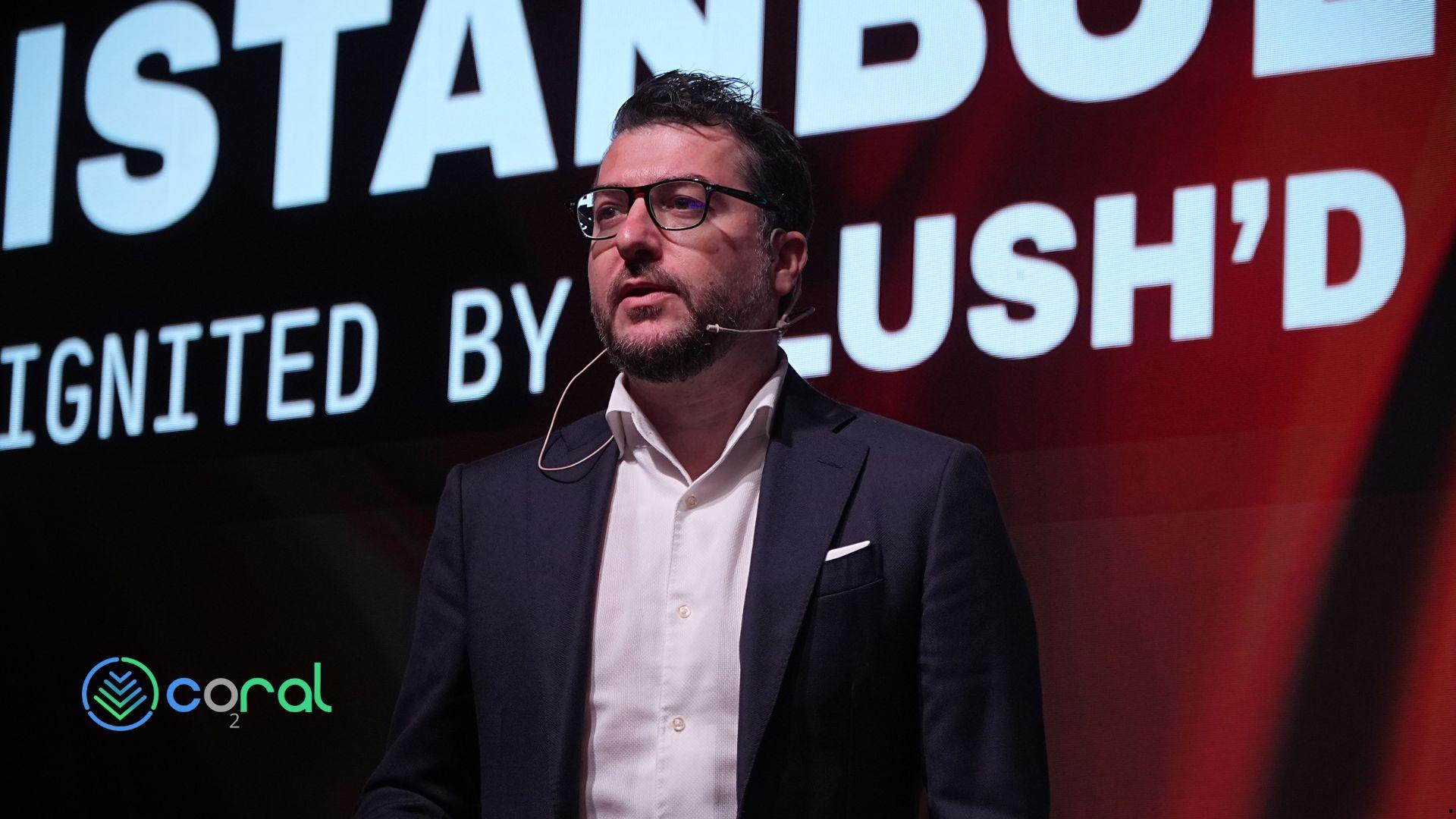
Coral has graduated from the 2026 Google for Startups Accelerator: MENA-T, closing the programme at Demo Day at Istanbul Ignited by Slush’D
Coral was one of 15 AI-first startups that Google selected for the cohort, which started on 1 June 2026. We worked with Google’s experts on our cloud architecture, data security and the AI workflows in our platform, from output generation to how we structure and query our data. At Demo Day, Daniele Sileri, CEO and […]
 Emissions Reporting15 Ekim 2026
AI Data Centres in the GCC: How to Measure Power, Water and Embodied Carbon
Every AI rack in the GCC carries four emissions sources: purchased electricity (Scope 2), backup generators and refrigerants (Scope 1), cooling water that is often desalinated, and embodied carbon in buildings and hardware (Scope 3). In our view, most operators can report electricity well, but few can report all four with evidence. As the UAE […]
 Carbon Markets & Climate Policy8 Ekim 2026
COP31 in Antalya: What Türkiye’s Presidency Means for GCC Companies
COP31 takes place in Antalya, Türkiye, from 9 to 20 November 2026, with Türkiye holding the Presidency and Australia chairing the negotiations. It will not create binding rules for GCC companies. But the summit’s flagship electrification pledge, Türkiye’s new emissions trading system and the EU’s Carbon Border Adjustment Mechanism (CBAM) will change what Turkish and […]