
Waste-to-Energy in Gulf Cities: Climate Solution or Incineration Greenwashing?
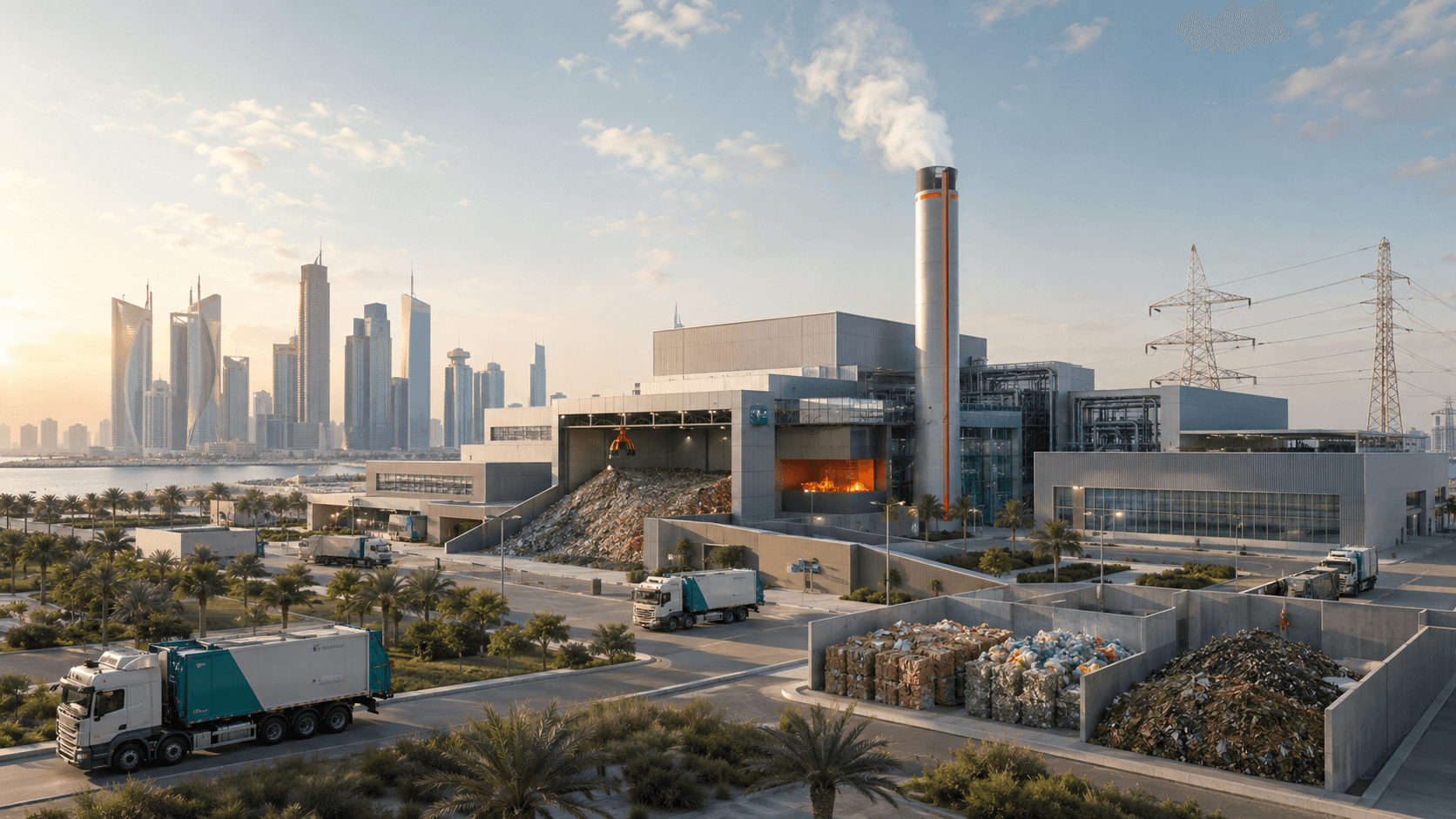
Burning rubbish to make electricity sounds like a magic trick. Waste disappears, the grid gets power, and a landfill the size of a neighbourhood never gets built. Dubai now runs a plant that does exactly this at a scale no other single site in the world matches. Sharjah got there first. Saudi Arabia plans gigawatts of it by 2030.
So the Gulf has clearly decided. The harder question is whether it was decided correctly.
Waste-to-energy (WtE) is any process that converts waste into usable energy, most commonly by burning non-recyclable municipal waste at high temperature to drive a steam turbine. Supporters call it a climate solution because it diverts waste from landfill and recovers energy. Critics call it incineration with a green badge stapled on, a carbon-intensive way to make electricity that quietly competes with recycling. This article lays out both cases honestly, looks at what is actually being built across the GCC, and gets to the part that matters most for any company with a net-zero target: how WtE shows up in your emissions numbers, and where the real greenwashing risk sits.
Key takeaways:
- Waste-to-energy burns non-recyclable waste to generate power. The GCC is among the world’s highest per-capita waste producers, which is a large part of why Gulf cities are building WtE at scale, with Saudi Arabia targeting 3GW of waste-to-energy capacity by 2030. (Source: Lexology, on GCC waste-to-energy projects)
- Dubai’s Warsan plant, billed as the world’s largest single-site facility of its kind, burns roughly 5,666 tonnes of municipal waste on a working day, generates up to 220MW (around 2% of Dubai’s annual electricity), and reached full commercial operation in September 2024. (Source: Global Construction Review)
- Sharjah’s Emirates Waste to Energy plant, the region’s first, processes around 300,000 tonnes of waste a year, powers about 28,000 homes, and is reported to offset roughly 450,000 tonnes of CO2 annually. (Source: Masdar, Sharjah Waste-to-Energy project)
- Incineration sits near the bottom of the EU waste hierarchy, above landfill but below recycling, and waste incineration has been excluded from the EU green taxonomy and from major EU climate financing. (Source: Zero Waste Europe, on WtE and the EU taxonomy)
- In February 2026, Dubai confirmed a Phase 2 expansion of the Warsan plant and reported it has already closed several landfills, working toward a goal of ending landfill dependency by 2041. (Source: Zawya, on Warsan Phase 2)
What waste-to-energy actually is, and what Gulf cities are betting on
Strip away the branding and WtE is mostly one process: mass-burn incineration. Mixed municipal waste is tipped into a bunker, fed into a furnace, and burned at high temperature. The heat boils water, the steam spins a turbine, and the turbine makes electricity. Modern plants then clean the flue gas to remove pollutants, capture metals, and turn the leftover bottom ash into aggregate for construction.
That is the standard model running in Sharjah and Dubai today. Other routes exist, such as gasification, pyrolysis, and anaerobic digestion, but in the Gulf the headline projects are conventional thermal plants.
The reason the region reached for them is uncomfortable but simple. The GCC produces enormous volumes of waste per person, among the highest rates anywhere, and historically sent most of it to landfill, as documented by Lexology. Land is valuable, populations are growing fast, and landfills generate methane, a greenhouse gas far more potent than CO2 over the short term. Against that backdrop, a plant that shrinks the waste mountain and produces power at the same time is an easy political and operational win.
The scale of the bet is real:
- Dubai (Warsan). The Dubai Waste Management Centre is billed as the world’s largest single-site WtE facility. It is designed to process around 1.9 million tonnes a year, roughly 45% of Dubai’s waste, and generate up to 220MW, as reported by CNN. It runs under a 35-year build-operate-transfer concession.
- Sharjah (Emirates Waste to Energy). A joint venture between Beeah and Masdar, this was the first such plant in the region. It handles around 300,000 tonnes a year and was designed to help Sharjah reach a zero-waste-to-landfill target, per Masdar.
- Saudi Arabia. Under Vision 2030, the Kingdom is targeting 3GW of waste-to-energy capacity by 2030, with major projects planned in Riyadh and Jeddah and backing from the Public Investment Fund, as covered by Lexology.
This is not a pilot phase. It is infrastructure with 30-year-plus contracts attached. That permanence is exactly why the climate question deserves a straight answer rather than a brochure.
The case for: why the Gulf reached for the incinerator
Take the strongest version of the pro-WtE argument, because it is genuinely strong in the Gulf context.
It beats landfill on methane. Organic waste rotting in a landfill releases methane, which traps far more heat than CO2 in the near term. Burning that waste instead avoids a slow methane leak that can run for decades. In a region that landfilled heavily for years, displacing landfill is a real climate gain, not an imaginary one.
It recovers energy from waste that has no better use. Some waste genuinely cannot be recycled economically: contaminated packaging, mixed materials, food-soiled paper. If that material is going to be destroyed anyway, recovering electricity from it is better than recovering nothing. The Warsan plant alone supplies enough power for well over 100,000 homes, according to CNN.
It frees up land and closes landfills. Dubai has reported closing landfill sites and is targeting an end to landfill dependency, a tangible outcome that matters in a dense, fast-growing city.
Modern plants are not the smokestacks of the 1980s. Today’s facilities run continuous emissions monitoring and flue-gas cleaning to strict standards. Sharjah’s plant was built to align with EU environmental standards on flue-gas treatment, as described by Arab Urban Development Institute. The image of unfiltered black smoke does not match a well-run 2020s facility.
If you stopped reading here, WtE looks like a clear win. The problem is that every one of these points has a counterargument that the brochures tend to leave out.
The case against: where “climate solution” becomes greenwashing
Now the other side, stated just as fairly.
Burning waste is carbon-intensive electricity. This is the inconvenient core. Each tonne of municipal waste incinerated typically releases between 0.7 and 1.7 tonnes of CO2, counting both fossil-based and biogenic sources, according to Zero Waste Europe. On a per-kilowatt-hour basis, the same analysis estimates WtE electricity at around 580g CO2 per kWh, roughly twice the carbon intensity of a modern decarbonising grid. Some advocacy analyses go further, arguing incineration can emit more greenhouse gas per unit of energy than coal, as summarised by Energy Tracker Asia. That figure is contested, but even the conservative numbers do not describe a clean energy source.
The plastic problem makes it worse over time. A large share of those emissions comes from burning plastic, which is fossil fuel in solid form. Less than 9% of the world’s plastic is recycled and global plastic production is projected to roughly double by 2040, as reported by Canary Media. More plastic in the bin means a dirtier burn. The US Environmental Protection Agency has found no significant climate benefit from substituting plastic for coal as a fuel, a point underlined by Energy Tracker Asia. Newer research has also flagged that plastics carrying “forever chemicals” can generate potent and persistent greenhouse byproducts that current testing does not fully capture, as reported by The Maine Monitor.
It can quietly cannibalise recycling. This is the most important structural critique. An incinerator is a hungry machine. It needs a constant flow of waste for 30 years to pay back its financing. That creates an incentive to keep waste volumes high rather than designing them down, which is the opposite of a circular economy. Zero Waste Europe describes how this “lock-in” can entrench linear waste flows, working against prevention and recycling, in its policy briefing on WtE and climate. If cheap WtE makes recycling look expensive by comparison, the plant can slow the very thing it claims to support.
The institutions setting the rules are sceptical. The EU waste hierarchy ranks incineration near the bottom, above only landfill and below recycling and reuse, as the European Environment Agency sets out. More pointedly, waste incineration has been excluded from the EU green taxonomy and from major EU climate financing on “do no significant harm” grounds, as Zero Waste Europe documents. When the world’s most developed sustainable-finance framework declines to call something green, labelling it a climate solution starts to look like a stretch.
The industry pushes back, and not unreasonably. Waste-management associations argue that energy recovery from genuinely non-recyclable residual waste is a recovery activity, not mere disposal, and that countries still dependent on landfill need it as a transitional bridge, a position set out by FEAD. That argument has merit. It also quietly concedes the key point: WtE is defensible only as a last resort for waste that truly cannot be recycled, not as a substitute for trying.
So which is it? The answer is in how you account for it
Here is the honest verdict. Waste-to-energy is neither a climate solution nor pure greenwashing. It is a waste-management tool whose climate value depends entirely on where it sits in the chain and how its impact is counted.
Used as the last step before landfill, for residual waste that has already been picked over for recyclables, it can beat the alternative. Used as a reason to stop trying to reduce and recycle, it becomes a fossil-fuelled power station wearing a recycling logo.
The greenwashing does not live in the furnace. It lives in the claim. A plant becomes a greenwashing exercise the moment its emissions are quietly dropped from the carbon ledger, its avoided-landfill benefit is double-counted, or its “renewable energy” label is taken at face value without separating the biogenic portion of the waste from the fossil-plastic portion. The technology is honest. Accounting is where things go wrong.
That is the part that matters for Coral’s audience, because the accounting risk is not only the municipality’s problem. It is yours.
What changed recently, and why it raises the stakes
Three recent developments move this from a debate into a near-term reporting issue across the GCC.
First, the Gulf’s WtE capacity is expanding, not pausing. In February 2026, Dubai confirmed it will launch a Phase 2 expansion of the Warsan plant this year, after the facility processed more than 4.5 million tonnes of waste since commissioning and diverted around 62% from landfill, per Zawya. The same reporting notes Dubai has closed landfill sites in Warsan, Jebel Ali, and Hatta, with remaining sites due to shut by 2027 on the way to a 2041 zero-landfill target. More waste will flow through incinerators, which means more emissions to account for, not fewer.
Second, Saudi Arabia is scaling a multi-billion-dollar pipeline. Riyadh, Jeddah, NEOM, and Qiddiya all feature in the Kingdom’s WtE plans, with PIF backing and public-private partnership models drawing in international developers, as covered by the Recycling Expo Middle East briefing. The GCC waste-management market overall is forecast to grow strongly through 2031, led by the UAE, according to Mordor Intelligence.
Third, the emissions science is getting less forgiving, not more. Through 2025, researchers continued to flag that plastic combustion produces a wider and more persistent range of greenhouse byproducts than most facilities report, as The Maine Monitor detailed. As the science tightens, “we burn it cleanly” becomes a claim that has to be evidenced, not asserted.
For the wider regional policy backdrop steering all of this, see our blog on what COP outcomes mean for UAE and Saudi net-zero plans.
What this means for GCC companies, not just municipalities
You may not own an incinerator. You almost certainly touch one. If your business operates in Dubai, Sharjah, or increasingly Saudi Arabia, a meaningful share of your waste already ends up at a WtE plant, and a small slice of the grid electricity you buy is generated there. Both facts have reporting consequences, and both are easy to get wrong.
The “zero waste to landfill” claim needs a caveat. Sending waste to a WtE plant lets a company say it diverted waste from landfill. That is true. It is not the same as saying the waste had no climate impact. Burning it produced emissions. A diversion claim that hides the combustion footprint is exactly the kind of statement that does not survive scrutiny.
Biogenic and fossil emissions are not the same, and the split matters. WtE emissions come partly from biogenic material such as food and paper, and partly from fossil material such as plastics. Greenhouse Gas Protocol accounting treats those differently, and the “renewable” framing usually leans on the biogenic share while staying quiet about the fossil-plastic share. Getting that split right, and disclosing it, is the line between an honest number and a flattering one. Because the choice of factors moves the result, see our blog on emission factors in the GCC and why two honest teams can report different footprints.
It lands in your Scope boundaries. Electricity drawn from a grid partly fed by WtE flows into your Scope 2. Waste your operations generate and send for treatment sits in Scope 3. Neither disappears because a third party burned it. If you are not sure where each piece belongs, see our blog on operational vs value chain emissions and how they map to Scope 1, 2, and 3.
Avoided-emissions claims are a credibility minefield. “We avoided X tonnes of landfill methane” is a tempting headline, and it is also where many WtE narratives quietly double-count. Avoided emissions are not the same as reduced emissions, and treating them as interchangeable is a classic greenwashing tell. The same integrity bar that applies to carbon credits applies here. For how that bar works when claims go “beyond carbon,” see our blog on credit integrity and regenerative agriculture in the GCC.
The pattern across all four is the same one that decides whether WtE is a solution or a slogan: the technology is fine, but the claim only holds up if the underlying data is governed, traceable, and audit-ready. A sustainability statement is only as trustworthy as the numbers beneath it, which is the whole argument of our blog on why ESG software has to earn three kinds of trust.
Where Coral fits
For sustainability, operations, and finance teams across the GCC, the hard part is not deciding whether WtE is good or bad. It is making sure that whatever you claim about waste, energy, and emissions is backed by numbers that hold up in front of an auditor, a regulator, or an investor.
That is where the work usually breaks. Waste-treatment data sits with facilities. Electricity data sits in utility invoices. The biogenic-versus-fossil split sits in nobody’s spreadsheet. The avoided-emissions story sits in a marketing deck with no traceable source. When those threads are scattered, a “zero waste to landfill” or “renewable energy” claim is impossible to defend the moment someone asks for the working.
Coral sits between that fragmented reality and decision-grade output. Coral’s Emissions Management System centralises operational data, measures Scope 1 to 3 emissions with the correct biogenic and fossil treatment, surfaces hotspots, and produces reporting aligned with the Greenhouse Gas Protocol and ISO 14064-1. Coral’s ESG Reporting extends the same governed dataset into structured disclosures aligned with GRI, ISSB, and the EU’s CSRD and ESRS, so the same waste and energy data can feed multiple frameworks without being re-massaged each time. To see how this maps to the rules now in force across the region, explore Coral’s regulations resource.
Next step
If your business sends waste to a WtE plant, buys power from a grid that includes one, or plans to make a zero-landfill or renewable-energy claim, the next step is to make those claims provable. Connect your waste, energy, and emissions data into one governed workflow before a disclosure deadline or an auditor turns a confident headline into an awkward question.
Explore Coral’s Emissions Management System, see how ESG Reporting fits into the same workflow, or book a demo to see what an audit-ready climate-data layer looks like for a GCC operation.
FAQ
Is waste-to-energy renewable?
Partly, and that is the catch. The portion of waste that is biogenic, such as food and paper, is often treated as renewable, while the portion that is fossil-based, such as plastics, is not. Calling the whole output “renewable” without separating the two is misleading. Several frameworks, including the EU green taxonomy, decline to classify waste incineration as sustainable at all.
Is waste-to-energy better than landfill?
For genuinely non-recyclable residual waste, usually yes, mainly because it avoids long-term methane emissions from rotting organic waste and recovers energy. That advantage disappears if the plant draws in material that could have been recycled, or if its combustion emissions are left out of the carbon accounting.
How much CO2 does burning waste produce?
Estimates suggest each tonne of municipal solid waste incinerated releases roughly 0.7 to 1.7 tonnes of CO2, combining fossil and biogenic sources. On a per-kilowatt-hour basis, the resulting electricity can be about twice as carbon-intensive as a modern decarbonising grid, which is why it is not considered clean power.
Why are Gulf cities building so many WtE plants?
The GCC is among the world’s highest per-capita waste producers and has historically relied on landfill. WtE diverts waste from landfill, recovers energy, and frees up land, which suits dense, fast-growing cities. Dubai’s Warsan plant and Sharjah’s Beeah-Masdar facility are operating now, and Saudi Arabia is targeting 3GW of capacity by 2030.
How does waste-to-energy affect a company’s emissions reporting?
In several ways. Grid electricity partly generated by WtE affects Scope 2. Waste your operations send for treatment affects Scope 3. “Zero waste to landfill” claims need to disclose the combustion footprint rather than hide it, and avoided-emissions claims must not be double-counted. The safest approach is to keep waste, energy, and emissions data in one governed, traceable workflow so every claim can be evidenced.
مقالات ذات صلة